For many exchange students and new residents, driving in Ireland eventually becomes a necessity after some time in the country. Although public transport works well in many regions, especially in larger cities, having the possibility to drive offers more autonomy to work, travel through the countryside, or simply move around with more freedom. The good news is that the process to obtain an Irish driver's license is quite organized and follows a structured system that prioritizes road safety and the proper training of new drivers.
The licensing system in Ireland is administered mainly by two official bodies. The Road Safety Authority (RSA) is responsible for the country's entire road safety structure, including defining the rules for driver training, applying tests, and training programs. The National Driver Licence Service (NDLS) is the service responsible for issuing and managing driver's licenses. In practice, those who wish to obtain an Irish license need to interact with both systems throughout the process.
Unlike some countries where you can do almost everything through driving schools, in Ireland, the process is divided into stages that combine individual study, practical training, and official evaluation. For those starting from scratch, the normal path usually involves four major phases: starting with the theory test, obtaining the so-called learner permit, completing a mandatory practical training program, and finally taking the practical driving test. Each of these stages has clear objectives and requires the candidate to demonstrate knowledge and responsibility before advancing.
Theory Test, the First Step to Driving in Ireland
The starting point for those who want to drive in Ireland is the Driver Theory Test, a theory test that assesses the candidate's knowledge of traffic rules, signage, road safety, and responsible behavior on the roads. This exam was created to ensure that new drivers understand the country's norms before they even start driving in practice.
The test can be scheduled online and is taken in authorized centers spread across various cities in Ireland. The test consists of multiple-choice questions that address common traffic situations, interpretation of signs, priorities at intersections, speed limits, and safe driving practices. Although many people underestimate this stage, it requires prior study and familiarity with the official driving manual published by the Road Safety Authority.
For those preparing, there are online simulators and apps that replicate the style of the exam questions. Using these resources helps a lot to understand how the test works and increases the chances of passing on the first attempt. On the day of the test, the candidate must present valid identification documents and follow the test center's instructions. After being approved in the Driver Theory Test, the candidate receives authorization to proceed to the next stage of the process.
Learner Permit, the License to Start Driving
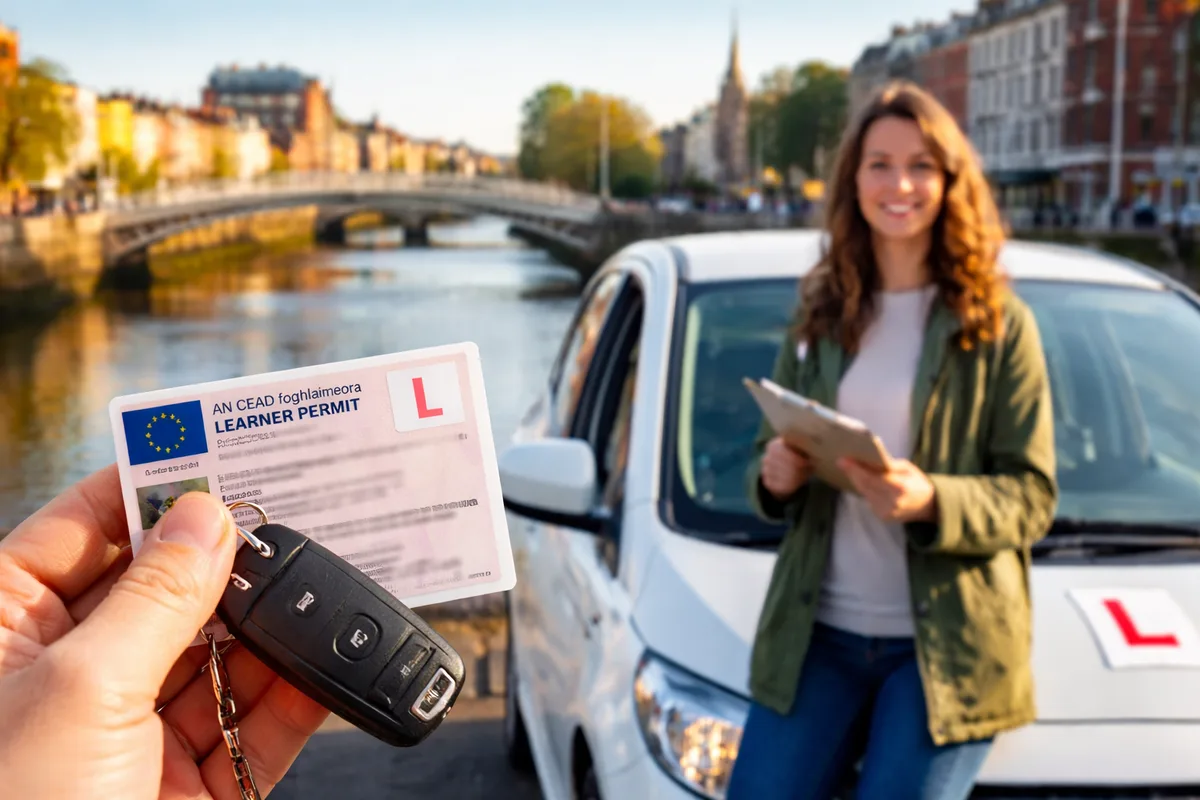
After passing the theory test, the next step is to apply for the Learner Permit, which serves as a learning license to drive in Ireland. This document allows the person to start practicing driving on public roads, but still under certain conditions established by Irish legislation.
The application for the learner permit is made through the National Driver Licence Service, which can be done online or in person at one of the NDLS centers. During the process, it is necessary to present documents that prove identity and residence in the country, in addition to the PPS number, which is the identification number used for various public services in Ireland. It is also necessary to pay the fee corresponding to the issuance of the license.
It is essential to understand that the learner permit does not grant complete autonomy to the driver. Those who possess this permit need to drive accompanied by a person who has had a full driver's license for at least two years. Additionally, the vehicle must display a plate with the letter L, indicating that it is a learner driver. These rules exist precisely to ensure that new drivers gain experience gradually and safely before driving alone.
Essential Driver Training, the Mandatory Training
An important feature of the Irish licensing system is the program called Essential Driver Training, known by the acronym EDT. This training was created to ensure that new drivers receive structured guidance before taking the practical driving test.
The program consists of 12 mandatory driving lessons, conducted with instructors approved by the Road Safety Authority. Each lesson addresses specific skills that every driver needs to develop, starting with basic vehicle control and gradually advancing to more complex traffic situations.
During the lessons, the student learns to handle different driving scenarios, such as urban traffic, rural roads, roundabouts, and parking maneuvers. The objective is not only to teach how to operate the car but also to develop situational awareness, constant observation of the environment, and safe decision-making while driving. Each completed lesson is recorded in an official system called MyEDT, which serves as a digital record of the training completed by the student.
This record is fundamental because completing the EDT program is one of the mandatory requirements to be able to schedule the practical driving test.
The Practical Driving Test
After completing the mandatory training and holding the learner permit for at least six months, the candidate can apply for the Driving Test, which is the practical driving test in Ireland. This stage is considered the final assessment before obtaining the definitive driver's license.
The practical test is scheduled through the official Road Safety Authority portal, called MyRoadSafety. On the day of the test, the candidate drives accompanied by an examiner who evaluates different aspects of driving. The objective is to verify if the driver is capable of driving safely, respecting traffic rules, and reacting correctly to common road situations.
Among the criteria evaluated are vehicle control, correct use of mirrors, observation of surrounding traffic, respect for signage, and the ability to make safe decisions while driving. The test usually includes driving in urban areas, roundabouts, direction changes, and parking maneuvers.
If the candidate passes, they receive a document called a Certificate of Competency, which officially proves that they passed the practical test.
Obtaining the Definitive Driver's License
After passing the practical test, the candidate can apply for the issuance of the definitive driver's license through the National Driver Licence Service. This process can be done online or in person at an NDLS center.
With the full license in hand, the driver is authorized to drive without supervision, something that is not allowed during the period they only have a learner permit. From this moment on, the driver is considered fully licensed within the Irish traffic system.
Brazilians Can Drive in Ireland with an International Permit
For Brazilians who are in Ireland only as visitors or who wish to rent a car during trips around the country, there is a simpler alternative. Those who have a valid driver's license in Brazil can use the International Driving Permit, known as PID.
The PID serves as an official translation of the Brazilian license and is usually accepted by car rental companies in Ireland. This allows tourists to rent a car and drive temporarily in the country without having to go through the entire Irish licensing process immediately.
However, this permit is temporary and does not replace the need to obtain an Irish license for those who intend to live in the country for a longer period. For residents, following the official process described above remains the only way to obtain permanent authorization to drive in Ireland.
Summary of the Process
The process to obtain a driver's license in Ireland usually follows these steps:
- Pass the theory test Driver Theory Test
- Apply for the Learner Permit
- Complete the 12 mandatory driving lessons of the EDT program
- Wait at least six months with the Learner Permit
- Take the practical driving test
- Apply for the definitive driver's license
If you are planning to drive in Ireland or still have questions about the process to obtain a driver's license in the country, it's worth remembering that much of this information can generate new questions along the way, especially for those who have just arrived.
The Irish Compass was created to help exchange students and new residents precisely in these first steps. Through the assistant available on WhatsApp, you can ask questions about transportation, documents, life in Cork, and other important topics for those starting their life in Ireland.
---
Official Sources
The information in this article is based on guidelines published by the bodies responsible for the licensing system in Ireland:
https://www.rsa.ie/services/learner-drivers
Authority responsible for road safety and driving tests in Ireland
Official page for information and scheduling of the theory test
https://www.rsa.ie/services/learner-drivers/learner-permit
Information on how to apply for a learner permit
https://www.rsa.ie/services/learner-drivers/driving-lessons/car-driving-lessons-(edt)
Mandatory training program with 12 driving lessons for new drivers
https://www.rsa.ie/services/learner-drivers/the-driving-test/how-to-apply
Portal to apply for and schedule the practical driving test
Service responsible for issuing driver's licenses in Ireland