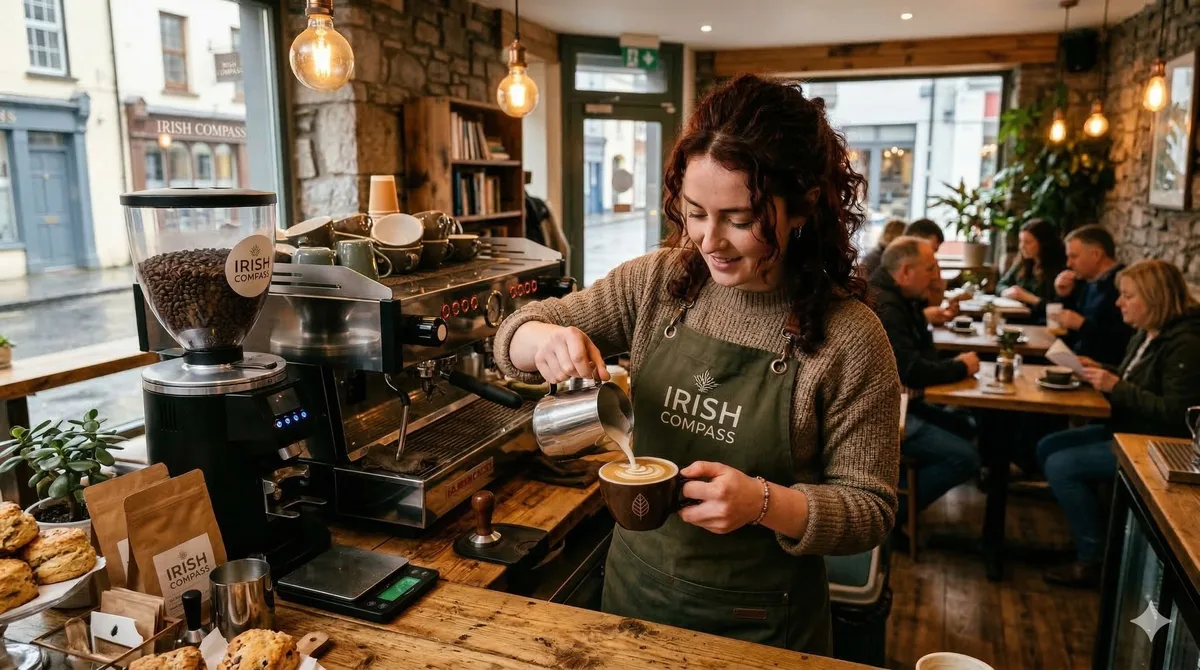
For many exchange students arriving in Ireland, working in coffee shops often becomes one of their first professional opportunities in the country. Coffee shops are an integral part of Irish daily life and are present in almost every city, ranging from small independent cafes to well-known chains like Costa Coffee, Starbucks, and Insomnia Coffee Company.
Beyond the large chains, there is also a strong culture of independent and artisanal coffee shops. In cities like Cork, Dublin, and Galway, it is common to find small cafes specializing in specialty coffee, local roasting, and environments geared towards those who appreciate a more complete experience with their beverage. This scenario creates many opportunities for those who wish to work in the field.
In this context, certain certifications have begun to appear frequently in barista courses and training in Ireland, including BSI and QBA. For those who are new to the country and considering working in the coffee industry, understanding what these acronyms mean can be very helpful when deciding whether or not to invest in a course.
What does the BSI certification mean
The BSI acronym is usually associated with barista training programs linked to the international standard of the Specialty Coffee Association. In many courses, BSI represents an intermediate level of knowledge in coffee, where the student learns more advanced techniques related to beverage preparation.
During this type of training, participants typically learn about correct espresso extraction, grinder calibration, grind control, milk steaming, and consistency in beverage preparation. These elements are fundamental to ensuring that the coffee served to the customer always has the same quality standard.
In practice, this means that the professional not only knows how to prepare a coffee but also understands how small adjustments in grinding, temperature, or extraction time can completely alter the flavor of the beverage. In specialty coffee shops, this type of knowledge is highly valued.
What is the QBA certification
The QBA certification, which usually appears as the Qualified Barista Award, is more related to basic or intermediate professional training for those who want to work behind the counter of a coffee shop.
The focus of this type of course is usually on teaching the operation of espresso machines, techniques for preparing classic beverages like cappuccinos and lattes, as well as notions of customer service and workstation organization.
Another important aspect of these trainings is the direct contact with professional equipment. Many people arrive in Ireland without having ever used a commercial espresso machine, and this type of practical experience ends up being very helpful when looking for the first job in a coffee shop.
Are certifications mandatory to work as a barista?
It is important to understand that in most barista job openings in Ireland, these certifications do not appear as a mandatory requirement.
What usually appears in job descriptions are requirements such as experience with espresso machines, the ability to prepare coffee beverages consistently, basic knowledge of latte art, and the ability to work in busy environments.
Even so, courses with BSI or QBA certification end up being useful for those who do not yet have experience. They function as a way to show the employer that the person has already had contact with professional equipment and understands the basics of a coffee shop's workflow.
For exchange students who have never worked with coffee before, this type of training can help reduce initial insecurity and facilitate the adaptation process to the work environment.
How do barista courses work in Ireland
Another advantage is that these courses are usually relatively short. Many barista trainings in Ireland take place over one or two intensive days, which is enough to teach the fundamentals of coffee preparation and allow the student to practice directly on professional machines.
There are also academies and schools specialized in barista training, where it is possible to find courses aimed at both beginners and professionals who want to deepen their knowledge of specialty coffee.
In many cases, the training includes practices such as grind adjustment, correct milk steaming, preparation of classic beverages, and introduction to latte art, which is the technique of creating designs on the surface of the coffee using steamed milk.
Working as a barista in Ireland
For exchange students starting their life in the country, this type of qualification can open doors to working in coffee shops, hotels, and restaurants.
Additionally, working as a barista also ends up being an interesting way to practice English in daily life, as contact with customers is constant and the environment is usually very dynamic.
Another positive point is that the coffee sector in Ireland continues to grow. In recent years, the country has seen a significant increase in the number of independent coffee shops and interest in specialty coffee, which further expands opportunities for those who want to work in this area.
By understanding what certifications like BSI and QBA mean, the exchange student begins to see more clearly how the coffee market works in Ireland and what paths are possible to get the first job in the area.
For those who are arriving in the country, information like this helps to avoid common doubts and make more secure decisions in the first months of adaptation.
The Irish Compass was created with this very objective, to help new exchange students and residents better understand how different aspects of life in Ireland work, from work and documentation to transportation, housing, and professional opportunities.
If you are planning to come to Ireland or are already in the country and want to understand better what paths exist to work, study, and get organized in the first months, you can talk directly to the Irish Compass's intelligent assistant on WhatsApp and receive practical guidance to start your journey with more clarity.